Beneteau - First 36 SE
Interior Design as a Weight Reduction Strategy
Client
Beneteau
Year(s)
2025
The First 36 SE explored how racing-driven weight reduction could still result in an interior that feels coherent, comfortable, and intentional.

The Challenge
Compared to the standard First 36, the 36 SE pursued an even more aggressive weight-reduction strategy to maximise racing performance. Alongside upgraded deck materials and a reduced wetted surface, the interior became another important area for optimisation. Together, these changes reduced the boat’s weight by 400 kg.
Performance and racing sailboat interiors are usually treated as as an exercise in functional reductions, resulting in spaces that feel unfinished and visually unbalanced. Every removed furniture element, textile liner, or interior component increases the risk of creating an interior that feels unfinished, fragmented, or purely utilitarian.
The challenge was to strip the interior down radically without making it feel incomplete, unresolved, or uncomfortable to inhabit.
Our Approach
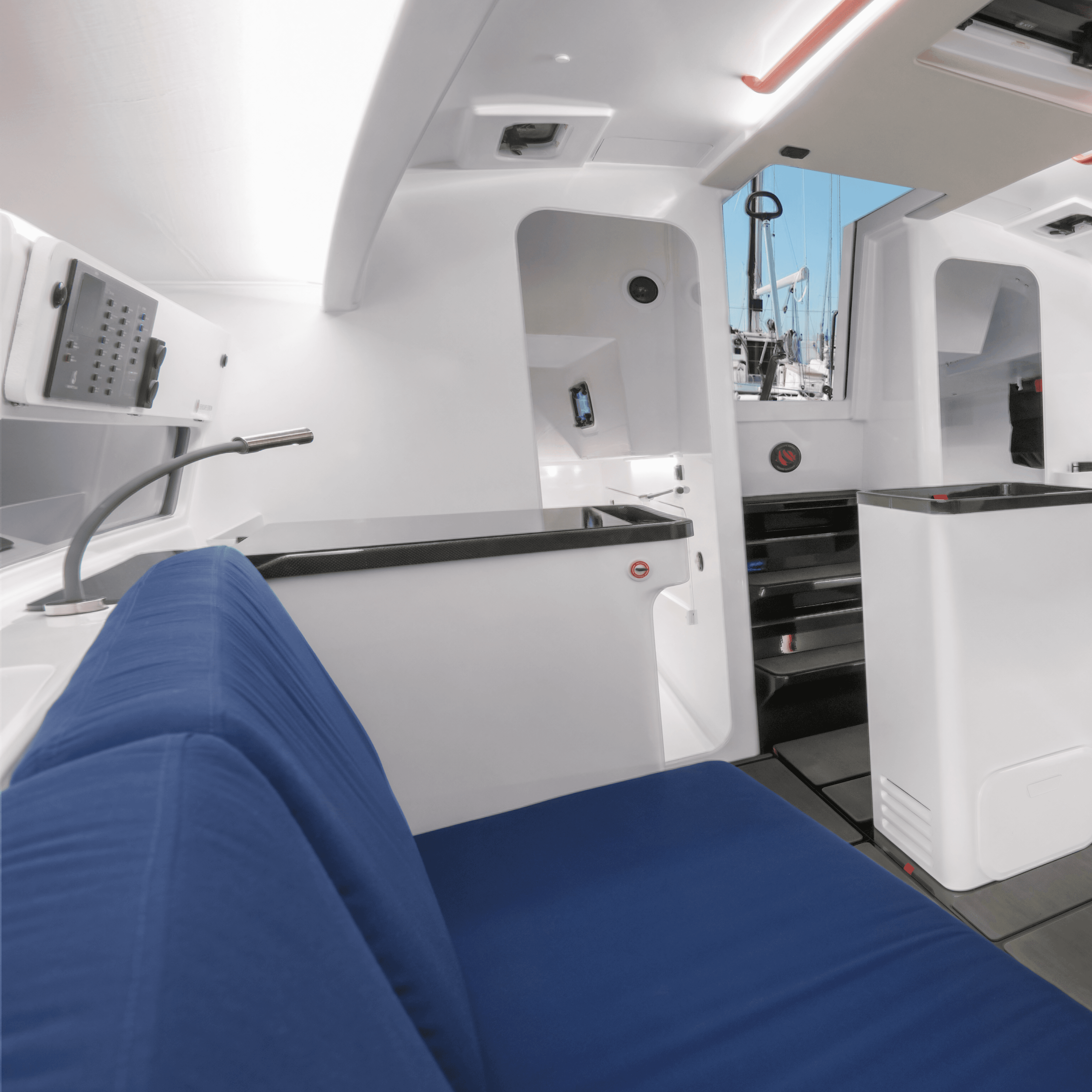
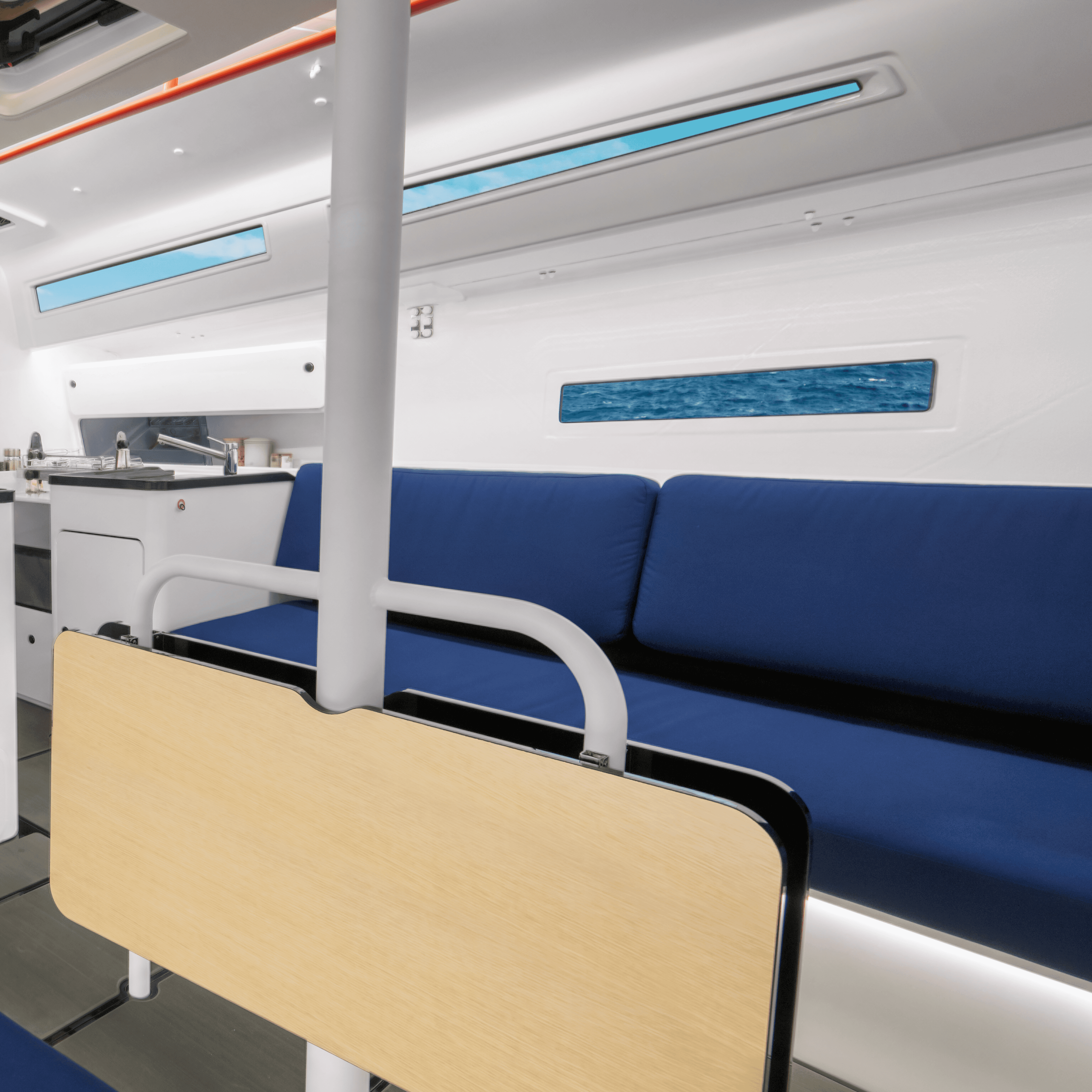
The interior was systematically re-engineered to eliminate unnecessary mass and replace conventional constructions with lighter, purpose-driven alternatives. This included the removal of non-functional liners and wooden furniture, as well as re-development of galley and navigation station, floorboards, companionway steps, saloon table and interior fittings.
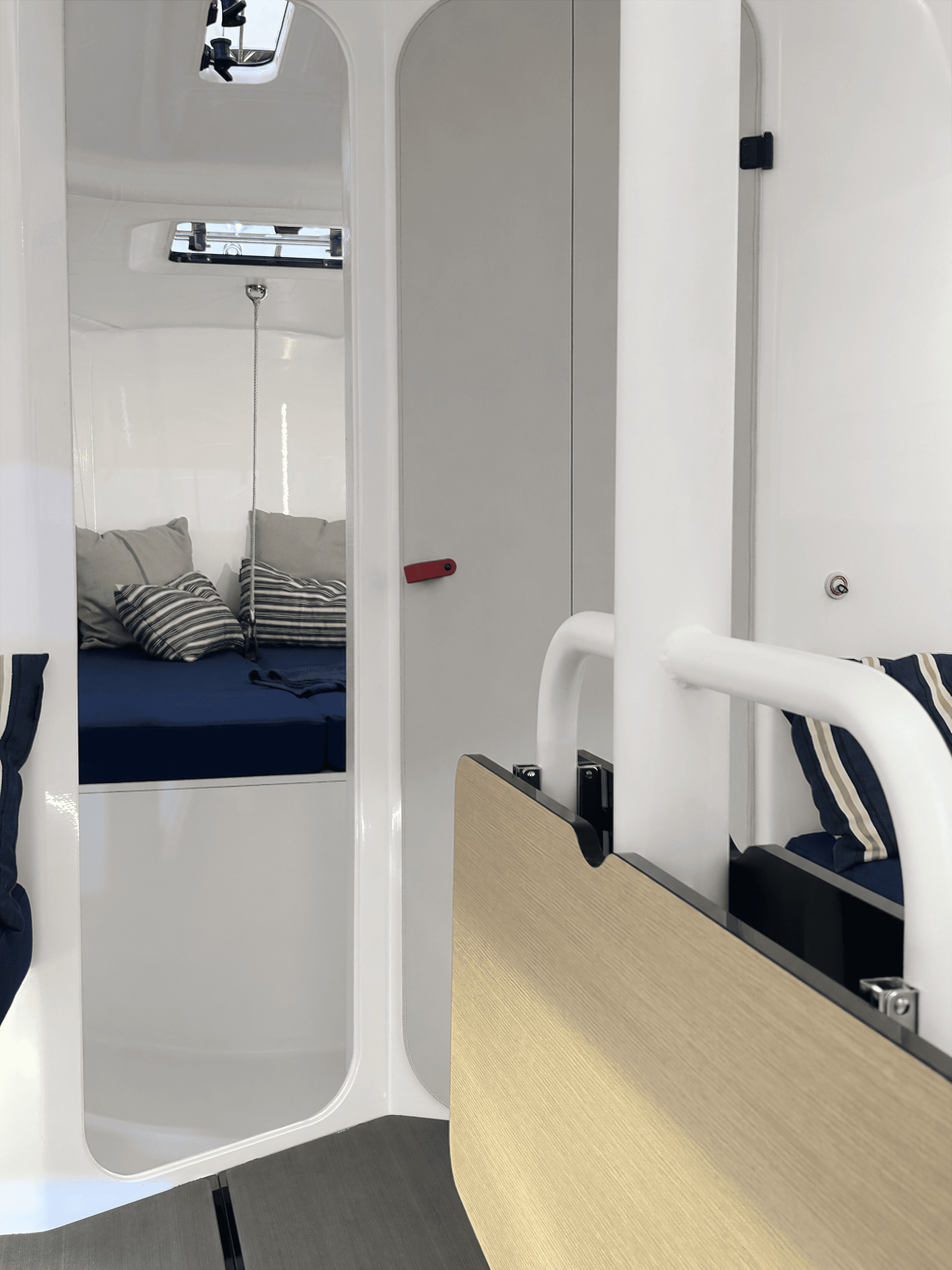
Rather than compensating for removed elements, the project focused on increasing the visual contribution of the elements that remained. Through contrast, proportion, and consistency, the interior was organised into clear functional zones that improved legibility, orientation, and perceived living quality despite significant material reduction.
Create clear functional volumes → Visually connected key functional volumes make the space feel less fragmented and equipment less isolated.
Establish visual hierarchy → Dark flooring and companionway steps are used to break down the predominantly light GRP and connect walking surfaces.
Clarify key functions → Distinct galley and navigation surfaces create clear visual cues around key onboard functions.
Define the social centre → Wooden table detailing and thicker, Beneteau-blue cushions help maintain a sense of comfort within the saloon.
Use colour selectively to guide interaction → Red and carbon-fibre details are used sparingly and purposefully to highlight important user touchpoints, such as fiddles, grabrails and handles.

The Outcomes
The resulting design allows the First 36 SE to bridge two traditionally separate worlds: a highly capable offshore racing platform and a genuinely pleasant living environment.
The project demonstrates that reducing weight does not automatically require sacrificing the quality of onboard living. Through restraint, coherence, and careful detailing, the interior remains pleasant to inhabit despite aggressive weight reduction.
Rather than adding comfort through additional materials and features, the result relies on visual organisation, clear hierarchy, and intentional detailing to make a highly reduced interior feel complete.

